Quick Answer:
-
The average rent for a one-bedroom flat in Dubai is AED 7,000 per month as of July 2026.
-
Dubai flat rental yields range from 6 to 9.5% annually across established freehold zones.
-
UK investors can rent a Dubai flat remotely through a licensed property management company.
-
Dubai rents rose year-on-year by 8.4% in 2026, confirming sustained tenant demand growth.
-
There is zero UAE income tax on rental income earned from a flat to let in Dubai.
The numbers on a flat to let in Dubai have never made more sense for UK investors. Rents in Dubai are rising with a year-on-year change of 8.4%, and the average gross rental yield in Dubai sits at 6.4% annually, a figure that climbs to 8 or 9% in the highest-performing mid-market zones. Set that against a UK buy-to-let market where higher-rate taxpayers net under 2% after HMRC restrictions, mortgage cost increases, and rising stamp duty surcharges, and the direction of capital becomes clear. British buyers already hold second place among all international investors in Dubai, accounting for 13.3% of total purchasing activity in early 2026 according to Harbor Real Estate.
The challenge for most UK investors considering a flat to let in Dubai is not the decision itself. It is the practical detail: which zones deliver the strongest yields, what rental prices the market actually supports in 2026, how to set up and manage a let from the UK, and what HMRC expects you to do with the income when it arrives in your account. Vague answers to these questions lead to either under-informed purchases or missed opportunities.
This guide covers everything you need to know about letting a flat in Dubai in 2026: current rent prices by area, yield performance by flat type, the legal framework governing Dubai lettings, how to manage the property remotely from the UK, and what your UK tax position looks like once the income starts flowing.
Dubai Flat Rental Prices 2026
Understanding current market rents is the starting point for any UK investor evaluating a flat to let in Dubai. Rental prices vary significantly by zone, flat size, building quality, and furnishing status. The figures below are drawn from current 2026 market data.
Studio Flat Rents
The average annual rent for a studio flat in Dubai in 2026 ranges from AED 45,000 to AED 70,000, with prime locations like Dubai Marina and Downtown commanding AED 60,000 to AED 70,000, while more affordable areas like Jumeirah Village Circle start from AED 38,000 to AED 45,000. For UK investors evaluating a studio flat to let in Dubai, the mid-market zone studios offer the strongest yield performance relative to purchase price. A JVC studio purchased at AED 650,000 and let at AED 50,000 per year generates a gross yield of approximately 7.7%, considerably ahead of equivalent studio flat yields in any major UK city.
Studios let quickly in Dubai's established zones. Correctly priced studios and one-bedroom apartments in Dubai Marina, JLT, Business Bay, Downtown Dubai, JVC, and Arjan can lease in 10 to 25 days. For UK landlords managing from a distance, fast let-up times reduce void periods and improve annual net yield performance.
One-Bedroom Flat Rents
The average monthly rent for a one-bedroom apartment in Dubai as of 2026 is approximately AED 6,700, with a realistic range of AED 3,200 to AED 14,000 per month depending on zone, building quality, and furnishing. The one-bedroom flat is the most popular investment format for UK buyers entering the Dubai market.
It attracts the broadest tenant base, including young professionals, couples, and corporate relocations, and sits in the sweet spot between yield and liquidity on resale. Dubai Marina one-bedroom flats achieve annual rents of AED 95,000 to AED 135,000, while Downtown Dubai one-bedrooms command AED 90,000 to AED 130,000 annually.
Two-Bedroom Flat Rents
Two-bedroom apartments in Dubai achieve average annual rents of AED 85,000 to AED 150,000, with premium areas like Downtown Dubai commanding AED 150,000 to AED 220,000 and mid-market zones offering two-bedrooms from AED 85,000 to AED 110,000. Two-bedroom flats in Dubai attract family tenants and corporate lets, typically on longer lease terms with lower turnover than studios and one-bedrooms. Annual service charges are proportionally higher for two-bedroom units but remain manageable in mid-market zones.
|
Flat Type |
Annual Rent Range (AED) |
Annual Rent Range (GBP approx.) |
Average Gross Yield |
|
Studio |
AED 38,000 – 70,000 |
GBP 8,000 – 14,700 |
7–9.5% |
|
One-bedroom |
AED 60,000 – 135,000 |
GBP 12,600 – 28,400 |
6.5–8.5% |
|
Two-bedroom |
AED 85,000 – 220,000 |
GBP 17,900 – 46,200 |
5.5–7.5% |
|
Three-bedroom |
AED 150,000 – 400,000 |
GBP 31,500 – 84,000 |
5–7% |
For UK investors seeking a flat to let in Dubai with the lowest tenant turnover and most stable income profile, a two-bedroom in an established family-friendly community such as Dubai Hills Estate or Jumeirah Village Circle is the natural recommendation.
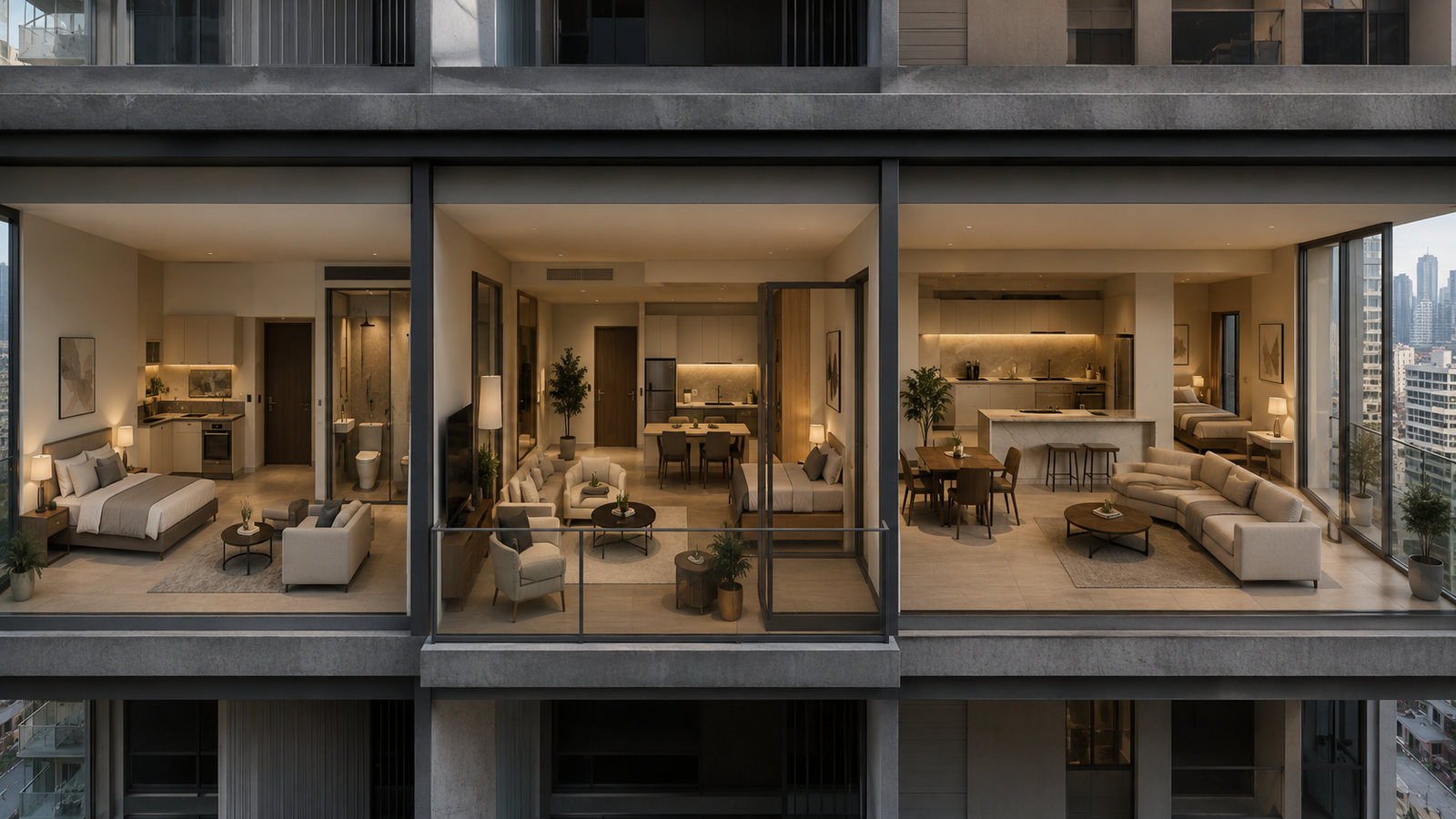
Best Zones for a Dubai Flat to Let
Location determines yield, tenant profile, void risk, and resale liquidity. Choosing the right zone before purchasing a flat to let in Dubai is the single most consequential decision in the investment process.
Jumeirah Village Circle
Al Furjan delivers average yields of 8.51% for studio flats, while Jumeirah Village Circle offers the best rental yields in prominent city-centre areas for larger units, with an average of 7.21% for three-bedroom flats in 2026. JVC is the most recommended zone for income-focused UK investors targeting a flat to let in Dubai. Entry-level studios start from AED 500,000 and one-bedrooms from AED 650,000 to AED 900,000, meaning yields of 7 to 9% are achievable from accessible investment levels.
The community's growing amenities, family-friendly environment, Metro proximity, and large off-plan pipeline from developers including Binghatti, Ellington, and Imtiaz support consistent occupancy rates year-round. Service charges of AED 12 to 18 per square foot keep net yields strong relative to premium zones.
Dubai Marina and JBR
Dubai Marina one-bedroom flats achieve annual rents of AED 95,000 to AED 135,000, and Dubai Marina annual rents for studios range from AED 80,000 to AED 110,000. Dubai Marina is the most established waterfront community for UK investors and delivers consistent 7 to 8.5% gross yields across all flat types. The area attracts an international tenant base of professionals, couples, and long-stay visitors in roughly equal measure, giving landlords flexibility between long-term and short-term letting strategies.
Entry prices for quality one-bedroom flats in Dubai Marina start from approximately AED 950,000 to AED 1.4 million. For short-term holiday home letting via a DTCM licence, Dubai Marina and Jumeirah Beach Residence deliver 20 to 40% higher gross income than equivalent long-term lets.
Business Bay and Downtown
Business Bay and Downtown Dubai together serve Dubai's corporate tenant base, drawing professionals from the nearby DIFC financial district and the broader UAE business community. Downtown Dubai one-bedroom flat rents range from AED 90,000 to AED 130,000 annually, up 10 to 15% from 2025, driven by new DIFC towers and limited supply.
|
Zone |
Studio Yield |
1-Bed Yield |
Entry Price 1-Bed (GBP) |
Tenant Profile |
|
Jumeirah Village Circle |
8–9.5% |
7–8.5% |
From GBP 135,000 |
Professionals, families |
|
Al Furjan |
8–9% |
7.5–8.5% |
From GBP 120,000 |
Families, professionals |
|
Dubai Marina |
7.5–9% |
7–8% |
From GBP 200,000 |
Expats, lifestyle tenants |
|
Business Bay |
6.5–8% |
6–7.5% |
From GBP 175,000 |
Corporate, DIFC professionals |
|
Downtown Dubai |
6–7.5% |
6–7% |
From GBP 280,000 |
Premium, executive tenants |
|
Dubai Hills Estate |
5.5–7% |
5.5–7% |
From GBP 220,000 |
Families, long-term tenants |
Business Bay delivers 5.5 to 7% gross yield with above-average capital growth, making it the strongest zone for UK investors seeking a balanced income and appreciation profile. A flat to let in Dubai's Business Bay or Downtown area appeals to corporate tenants on company-paid leases, producing stable annual income with low void risk.
Legal Framework for Dubai Lettings
Before setting up a flat to let in Dubai, UK investors must understand the legal framework that governs all residential tenancies. Dubai's tenancy law is clear, well-enforced, and considerably more landlord-friendly than UK legislation.
RERA Tenancy Law
All residential tenancies in Dubai are governed by Tenancy Law No. 26 of 2007 and its 2010 amendment, administered by the Real Estate Regulatory Agency (RERA). Annual rent increases are controlled by the RERA Rental Index, which caps the permitted increase based on the gap between the current rent and the prevailing market rate.
New tenancies are not subject to the rent increase cap, meaning landlords can set the opening rent at full market rate. For UK investors renting a flat in Dubai for the first time, this distinction is important: you capture the full 2026 market rent from day one, not a suppressed rate inherited from a previous tenancy.
Ejari Registration
All tenancy agreements for a flat to let in Dubai must be registered through the Dubai Land Department's Ejari system before the tenant can access DEWA (Dubai Electricity and Water Authority) utilities. Ejari registration creates an official record of the tenancy, is required for any future rent dispute resolution at the Rental Disputes Centre, and confirms the landlord's legal standing under Dubai tenancy law.
Your property management company handles Ejari registration as part of the standard letting process. The registration fee is minimal. Failure to register exposes the landlord to complications in any future dispute.
Short-Term Let Licensing
Short-term letting a Dubai flat on Airbnb, Booking.com, or similar platforms requires a Holiday Home licence from the Dubai Department of Tourism and Commerce Marketing. The annual licence costs AED 1,520 to AED 2,920 depending on property size and must be renewed each year. Properties must meet DTCM standards for furnishing, safety, and guest facilities.
|
Letting Type |
Licence Required |
Income Premium |
Management Fee |
Best Zones |
|
Long-term (12 months) |
Ejari only |
Baseline |
8–10% of annual rent |
All established zones |
|
Short-term (holiday home) |
DTCM licence |
20–40% above LT |
20–25% of revenue |
Marina, Downtown, JBR |
|
Corporate let |
Ejari only |
10–20% above LT |
8–10% of annual rent |
Business Bay, Downtown |
Short-term letting generates 20 to 40% higher gross income than long-term letting in the same zone, particularly in Dubai Marina, Downtown, and JBR. A licensed property management company operating as a holiday home operator can manage the DTCM licence, guest check-in, cleaning, and platform listings on your behalf.

Managing Your Dubai Flat from the UK
One of the most practical advantages of a flat to let in Dubai is how well the management model accommodates UK-based landlords who cannot be present in the UAE.
Property Management Setup
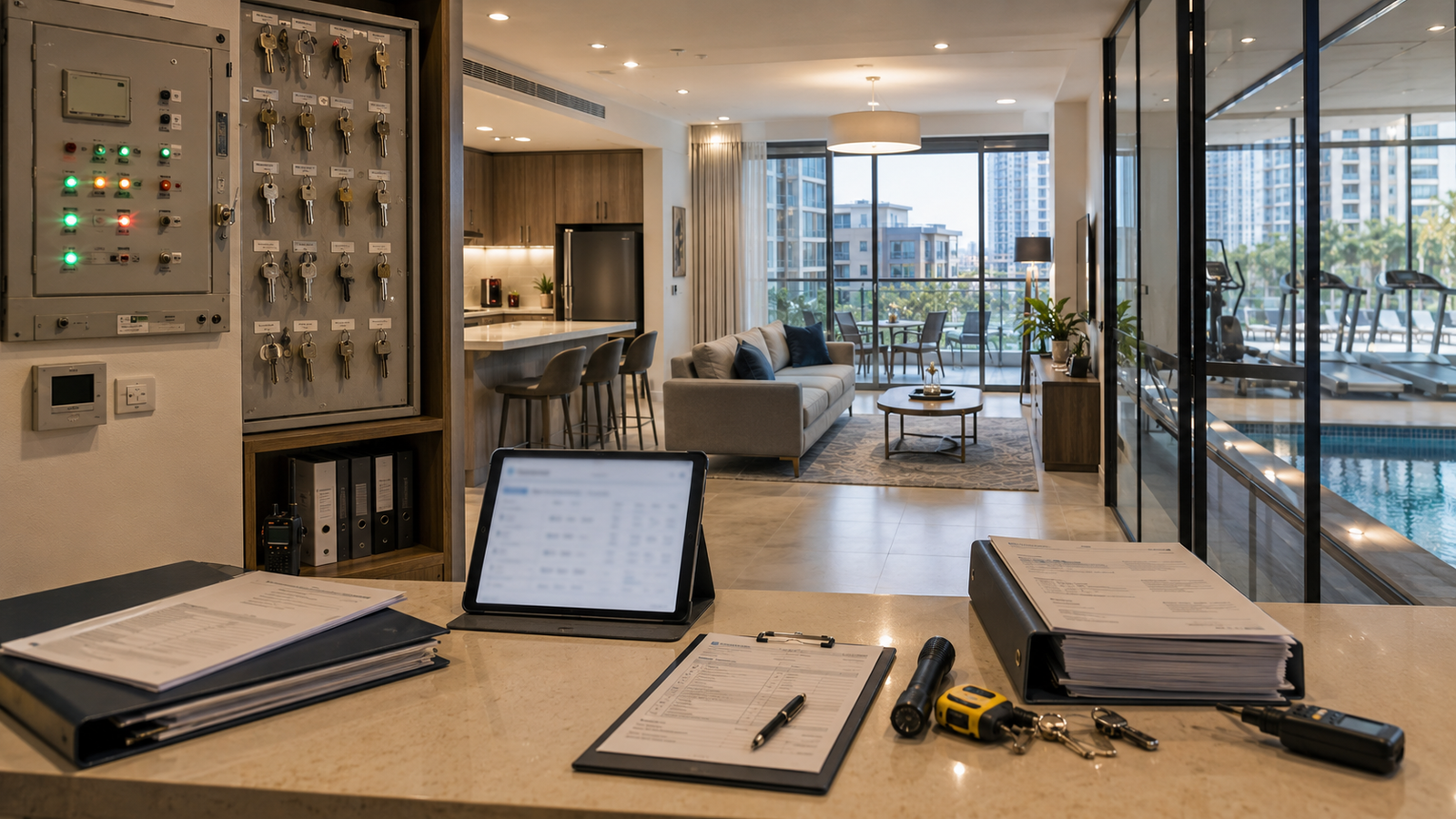
A licensed Dubai property management company handles the entire letting cycle on behalf of UK-based landlords. Services include tenant sourcing and vetting, tenancy agreement preparation, MOU signing via Power of Attorney, Ejari registration, DEWA setup, rent collection, maintenance coordination, and RERA compliance.
Management fees for long-term lets run 8 to 10% of annual rental income. These fees are fully deductible against your UK Self Assessment income declaration, reducing your HMRC tax liability. From years of advising UK investors on Dubai property, we have consistently seen that investors who appoint a RERA-registered management company from day one maintain higher occupancy rates and experience fewer tenant disputes.
Rent Collection Structure
Rent in Dubai is paid upfront at the start of the tenancy, either as a single annual cheque or in two to four post-dated cheques covering the full tenancy period. This gives UK landlords considerably more income certainty than the monthly rolling payment model common in Britain. In practical terms, most studios in Dubai rent for AED 2,500 to AED 7,500 per month, and a correctly priced studio in an established zone can lease in 10 to 25 days.
Your management company collects the cheques, deposits them, and transfers your net rental income to your UK bank account monthly or quarterly. The AED is pegged to the USD, so your GBP receipts will fluctuate with the GBP to USD exchange rate. Planning your currency conversion in advance produces more predictable sterling returns.
Maintenance and Service Charges
Annual service charges in Dubai cover building maintenance, security, lifts, pools, and shared amenities. They are levied by the building's management company and range from AED 10 to AED 35 per square foot annually depending on zone and building quality. On a 700 square foot one-bedroom flat, that represents AED 7,000 to AED 24,500 per year, approximately GBP 1,470 to GBP 5,150.
Service charges are not covered by tenants in Dubai. They are the landlord's cost. Always request the actual service charge history for the specific building before purchasing, as developer estimates frequently understate the real figure. In CHILLER-FREE buildings, tenants pay their own district cooling costs directly to the provider, removing a significant variable expense from the landlord's cost base.
Accurate service charge budgeting at the point of purchase prevents the most common net yield disappointment UK investors experience after completion.
UK Tax on Dubai Flat Income
Self Assessment Requirements
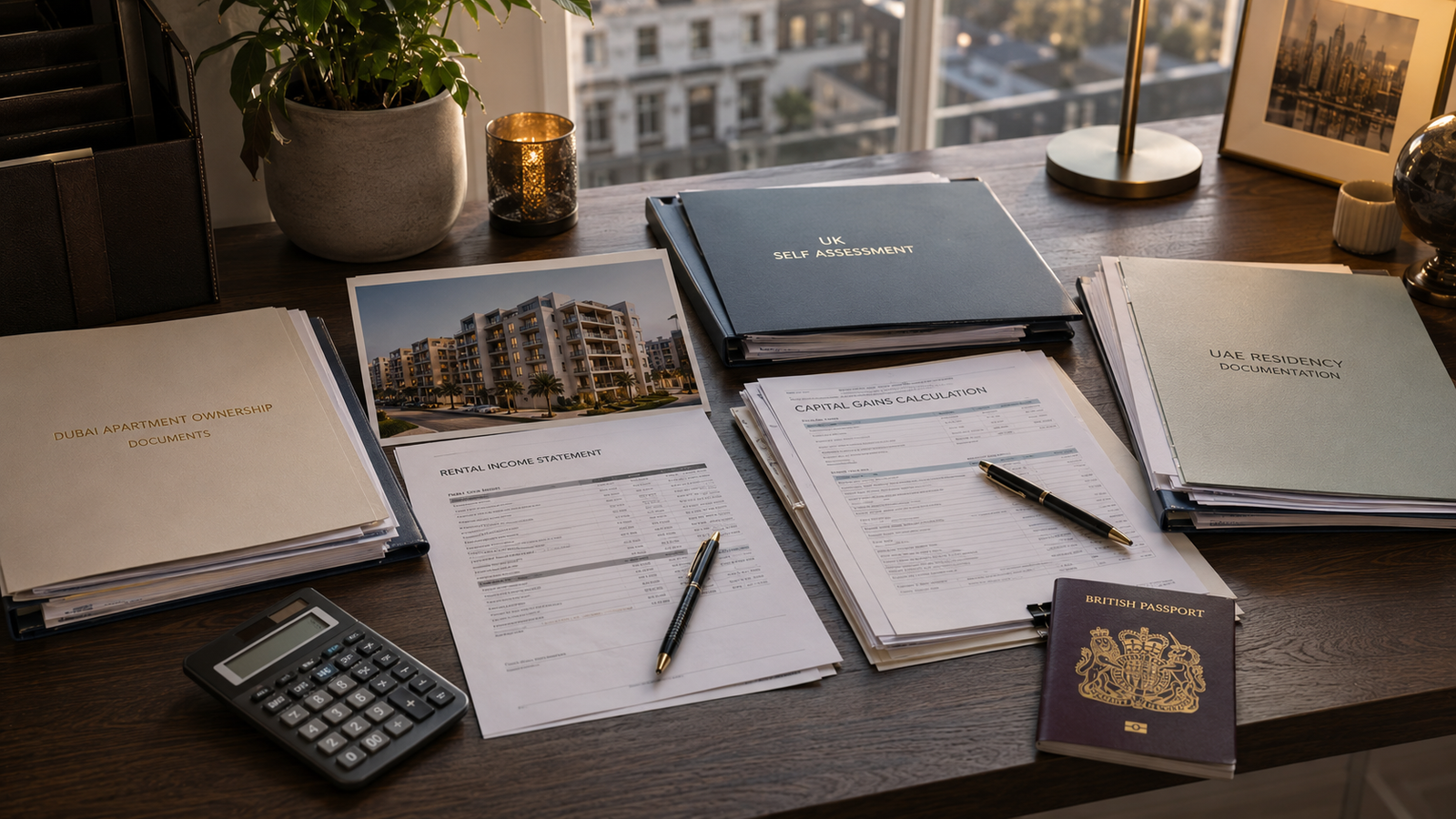
UK tax residents must declare all rental income from a flat to let in Dubai on their Self Assessment tax return each year in the foreign income section. The UAE charges zero income tax on rental earnings. The UK-UAE Double Taxation Agreement ensures you are not taxed twice on the same income.
You declare gross rental income, deduct allowable expenses, and pay UK income tax at your marginal rate on the net amount. Allowable deductions include property management fees, maintenance costs, building insurance, DTCM licence fees for short-term lets, and mortgage interest at the 20% tax credit rate for individual landlords.
Capital Gains on Sale
When you sell a Dubai flat, the UAE charges zero capital gains tax. HMRC treats the gain as a foreign capital gain subject to UK CGT at 18% for basic-rate taxpayers and 24% for higher-rate taxpayers on residential property, with a GBP 3,000 annual exemption.
Married couples and civil partners who hold the flat jointly can use both annual exemptions and benefit from a potentially lower tax band on disposal. The longer you hold the property and accumulate rental income, the stronger the total return justification for the eventual CGT liability.
Golden Visa Qualification
UK investors who purchase a flat or portfolio of flats in Dubai reaching a combined Dubai Land Department registered value of AED 2 million qualify for the UAE's 10-year Golden Visa. The visa provides renewable UAE residency for the investor and their family, without any minimum stay requirement.
For UK investors who choose to establish formal UAE tax residency under HMRC's Statutory Residence Test, this pathway opens access to the UAE's zero personal income tax environment on worldwide income. This is a material long-term planning opportunity for high-net-worth UK investors building a Dubai flat portfolio.
Ready to Let a Flat in Dubai?
A flat to let in Dubai in 2026 delivers everything UK buy-to-let no longer can: yields of 6 to 9.5%, zero UAE income tax, a landlord-friendly legal framework, stable upfront rent payment, and a management model that operates fully remotely from the UK.
Dubai rents rose 8.4% year-on-year in 2026, vacancy periods in established zones run 10 to 25 days for correctly priced units, and British investors now account for 13.3% of all international purchases in the market.
Register for the Dubai Property Expo UK at dubaipropertiesexpo.co.uk and meet 100+ RERA-verified developers to find the right flat to let in Dubai for your investment goals in 2026.
Frequently Asked Questions
How much does a flat in Dubai cost to buy in 2026?
Entry prices for a flat to let in Dubai vary significantly by zone and flat type. Studios in mid-market communities such as Jumeirah Village Circle start from approximately AED 500,000, equivalent to GBP 105,000. One-bedroom flats in JVC range from AED 650,000 to AED 950,000, while Dubai Marina one-bedrooms typically start from AED 950,000 to AED 1.4 million. Total acquisition costs add 6 to 9% above the purchase price, covering the 4% Dubai Land Department transfer fee, 2% agent commission, title deed registration, and legal costs. Off-plan payment plans from 10 to 20% deposits allow UK investors to enter the market with a fraction of the total flat value upfront.
What rental yield can I expect from a flat to let in Dubai in 2026?
Gross rental yields for Dubai flats in 2026 range from 6% to 9.5% depending on zone and flat type. Studios in Al Furjan deliver average yields of 8.51% according to Global Property Guide data. JVC three-bedroom flats average 7.21% gross yield. One-bedroom flats in Dubai Marina yield 7 to 8% gross, while Downtown Dubai one-bedrooms yield 6 to 7% with stronger capital growth. Net yields after management fees, service charges, and maintenance typically run 1.5 to 2 percentage points below gross. Even at net yield levels, Dubai flat returns significantly outperform comparable UK buy-to-let net yields for higher-rate taxpayers in 2026.
Can I let my Dubai flat short-term on Airbnb?
Yes. Short-term letting a Dubai flat on Airbnb or Booking.com is legal and increasingly popular in 2026, but requires a Holiday Home licence from the Dubai Department of Tourism and Commerce Marketing. The annual licence costs AED 1,520 to AED 2,920 depending on flat size. Short-term letting in premium zones such as Dubai Marina, Downtown, and JBR typically generates 20 to 40% more gross income than an equivalent long-term tenancy. A licensed holiday home operator manages the DTCM licence, platform listings, guest check-in, and cleaning on your behalf. Always confirm your management company is DTCM-authorised before listing.
Do I have to declare Dubai flat rental income to HMRC?
Yes. As a UK tax resident, you must declare all rental income from a flat to let in Dubai on your Self Assessment tax return each year, even though the UAE charges zero tax on that income. The UK-UAE Double Taxation Agreement prevents you from being taxed twice. You declare gross rental income and deduct allowable expenses including management fees, maintenance, insurance, and mortgage interest before calculating your UK tax liability. Penalties for non-disclosure of foreign income are significant. Full guidance on foreign rental income obligations is available at gov.uk/self-assessment-tax-returns.
What happens if my Dubai flat tenant stops paying rent?
Dubai's tenancy law provides landlords with clear and enforceable legal recourse for non-payment. If a tenant's post-dated cheque is returned unpaid, the landlord can file a complaint with the Rental Disputes Centre at the Dubai Land Department. The RDC adjudicates rental disputes efficiently, typically within weeks rather than months. Eviction orders for non-payment follow a defined legal process. Compared to UK eviction procedures, which regularly take six months or more, Dubai's dispute resolution system is considerably faster and more landlord-friendly. Valid Ejari registration is a prerequisite for any formal RDC complaint, confirming why registration at the start of every tenancy is non-negotiable.