Quick Answer
-
File online through the RDC portal
-
Mediation runs before any tribunal hearing
-
Fees are 3.5% of annual rent
-
Ejari registration required before filing
-
HMRC taxes your Dubai rental profit
Owning rental property in Dubai sounds simple until a tenant stops paying or refuses to leave. For UK landlords sitting thousands of miles away, a rental dispute in Dubai can feel overwhelming when you do not know which authority handles your case or how to file from London.
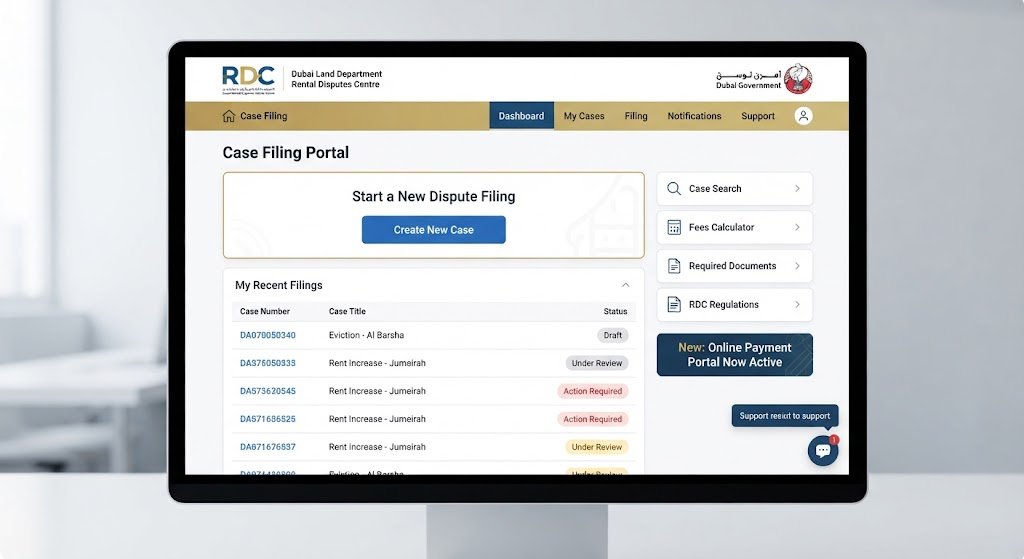
The good news is that Dubai has a dedicated legal body for exactly this. The Rental Disputes Centre operates under the Dubai Land Department and handles every landlord and tenant case in the emirate. You can file online, attend hearings remotely, and resolve most cases within 30 to 45 days without flying out.
This guide covers the full RDC filing process, fees, documents, timelines, how to manage the case from the UK through power of attorney, and where your rental income sits with HMRC.
What the RDC Covers
The Rental Disputes Centre is the only body with jurisdiction over a rental dispute in Dubai. No other court handles tenancy complaints in the emirate.
Covered Disputes
The RDC handles a wide range of cases that affect UK landlords who let property in Dubai:
-
Unpaid rent and bounced cheques
-
End-of-lease eviction challenges
-
Security deposit disagreements
-
Rent increase disputes under Decree No. 43 of 2013
-
Illegal subletting claims
-
Property damage beyond normal wear and tear
-
Maintenance obligation disputes
The centre works both ways. Tenants can also file against landlords, so UK owners need to keep their obligations current to avoid counterclaims.
Legal Framework
Dubai's tenancy law sits under Law No. 26 of 2007, amended by Law No. 33 of 2008. One critical point UK landlords must understand is the difference between two notice periods:
-
Article 14 covers rent changes at renewal and requires 90 days' written notice before the lease expires
-
Article 25 covers eviction and requires 12 months' written notice served through a Notary Public or registered mail
These two timeframes are not interchangeable. Confusing them is one of the most common mistakes landlords make when facing a tenancy case.
Article 28 also protects tenants during a sale. When ownership transfers, the buyer inherits:
-
The sitting tenant and their right to stay
-
The agreed rent amount on the current lease
-
The remaining lease term until its expiry date
A UK landlord who buys a tenanted unit cannot remove the tenant until the lease expires, even with a valid eviction ground.
Filing Eligibility
Any property owner can file at the RDC regardless of nationality or residency. The following parties have standing:
-
Property owners (UAE resident or non-resident)
-
Tenants filing against a landlord
-
Property management companies with a valid trade licence and management contract
-
Legal representatives holding a notarised power of attorney
For UK landlords managing a case remotely, a notarised power of attorney is the standard route. Your representative files and attends hearings on your behalf. The power of attorney must be attested by a UAE embassy or consulate, and the RDC charges AED 500 to register it on the case file.
When you buy property in Dubai from the UK, setting up a power of attorney early saves time if a dispute arises later.
Filing Process Step-by-Step
Filing at the Rental Disputes Centre follows a clear process designed so overseas owners can handle most steps online.
Required Documents
You need to gather these before submitting your case:
-
A valid Ejari registered tenancy contract
-
Your passport copy (Emirates ID not required for non-residents)
-
Proof of rent payments: bank transfers, cheque copies, or receipts
-
All written correspondence with the tenant
-
Any notices served, with proof of delivery
-
A bank letter showing your IBAN for financial claims
Every document in English must be translated into Arabic by a Ministry of Justice certified translator. Submitting untranslated documents can delay or derail your case.
The table below sets out the documents by case type.
|
Case Type |
Core Documents |
Extra Proof Needed |
|
Unpaid rent |
Ejari contract, payment records |
Bounced cheque details, 30-day notice |
|
Eviction at expiry |
Ejari contract, 12-month notice |
Notary Public delivery proof |
|
Deposit dispute |
Ejari contract, deposit receipt |
Check-in/check-out reports, photos |
|
Rent increase challenge |
Ejari contract, Rental Index check |
90-day written notice proof |
The RDC generally does not allow new documents after the initial submission, so everything needs to be right the first time.
Online Filing
The fastest route is the RDC online portal. The steps are straightforward:
-
Create an account on the portal
-
Enter the tenancy contract details and your claim
-
Upload all supporting documents
-
Pay the filing fee by card or online payment
-
Receive your case number immediately
The system notifies the other party once the case is registered.
UK landlords can also file through the Dubai REST app. Hearings run through the tele-litigation system, so you can attend from anywhere. This makes handling a case practical for landlords who let houses in Dubai from the UK.
The alternative is filing in person at a Real Estate Services Trustee Centre in Deira, where an RDC typist helps prepare the claim for AED 130 plus VAT.
Mediation First
Every case at the RDC starts with the Mediation and Conciliation Directorate. A conciliator meets both parties and tries to reach a voluntary settlement within 15 days. The supervising judge can extend this by the same period.
If the mediation succeeds, the signed agreement carries the force of a writ of execution. It can be enforced directly without a hearing. Half the registration fee is also refunded when a rental dispute in Dubai settles at this stage.
If mediation fails, the case moves to the First Instance Division where a tribunal hears both sides and issues a binding judgment.
Fees, Timeline and Appeals
Understanding the cost before you file helps you decide whether the claim is worth pursuing.
Fee Schedule
The table below shows the RDC fee schedule from the DLD's published rates.
|
Fee Type |
Rate |
Cap |
|
Eviction, renewal, or termination |
3.5% of annual rent |
AED 500 min, AED 20,000 max |
|
Financial claims (rent, deposit) |
3.5% of claim value |
AED 500 min, AED 15,000 max |
|
Power of attorney registration |
AED 500 flat |
AED 500 |
|
Advertisement and admin fees |
AED 120 combined |
AED 120 |
|
Trustee Centre service |
AED 130 + VAT |
AED 130 + VAT |
For a property rented at AED 120,000 per year (roughly GBP 26,000), the filing fee on an eviction case is AED 4,200 plus admin charges. Factor these costs into your yield when assessing the risks of buying property in Dubai.
Typical Timeline
The RDC moves faster than most UK courts on tenancy cases. The table below shows typical durations at each stage.
|
Stage |
Duration |
What Happens |
|
Mediation |
15 to 30 days |
Conciliator tries to reach a voluntary settlement |
|
First Instance |
30 to 120 days |
Tribunal reviews evidence, issues a ruling |
|
Appeal |
30 to 90 days |
Higher tribunal reviews (claims above AED 100,000 only) |
|
Enforcement |
Varies |
Execution Department carries out the order |
Most mediated cases close within 30 to 45 days. Contested cases with expert reports take longer. The remote hearing option means you do not need to fly to Dubai for any stage.
Filing does not suspend the tenant's rent obligations. If the tenant stops paying during the dispute, the unpaid rent adds to the claim amount.
Appeal Limits
Under Decree No. 26 of 2013, not every judgment can be appealed. The rules work like this:
-
Claims below AED 100,000 are final at First Instance with no appeal available
-
Claims above AED 100,000 can be appealed within 15 days of the hearing date
-
The appellant must deposit the full judgment amount before the appeal proceeds
-
The RDSC chairman may waive or reduce the deposit in exceptional cases
Most residential deposit disputes fall below AED 100,000, so the first hearing is your only chance to present evidence fully.

UK Tax on Dubai Rent
The dispute process is one side of the equation. The other is making sure you report the income correctly to HMRC.
HMRC Reporting
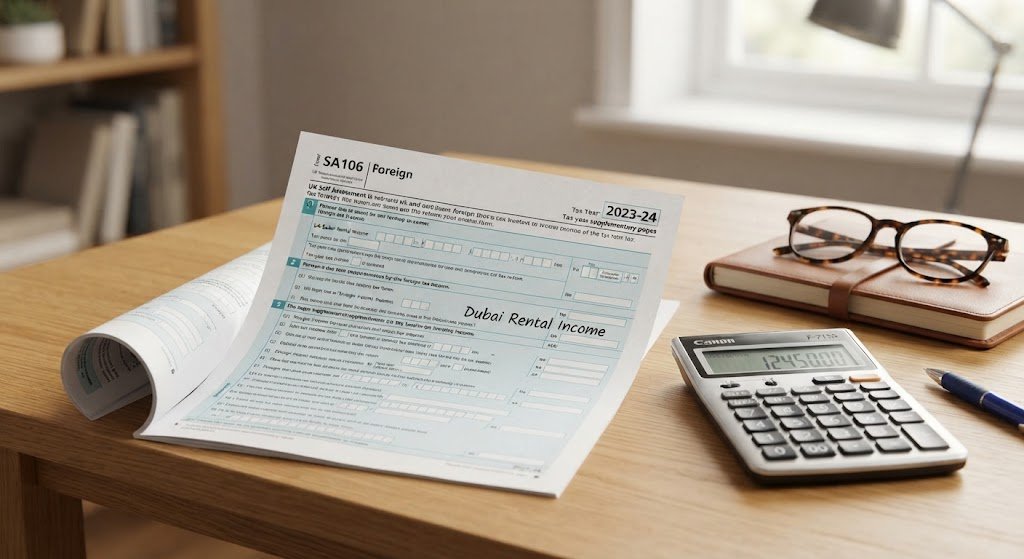
UK residents must report worldwide income, including Dubai rental earnings. You use form SA106 on your Self Assessment return. Boxes 14 to 24.2 cover the property income, and boxes 25 to 32 handle the summary.
Deductible expenses follow the same rules as a UK rental:
-
Property management fees and letting agent commissions
-
Maintenance, repairs, and insurance
-
Service charges and ground rent
-
Legal and professional fees
A few rules differ from a standard UK rental:
-
Mortgage interest cannot be deducted as an expense on residential property
-
You claim a 20% tax credit on finance costs instead
-
Dubai charges no income tax on personal rental earnings
-
Column C of the SA106 (foreign tax paid) will be zero
-
Your net rental profit is taxed at your marginal UK rate: 20%, 40%, or 45%
Because there is no UAE tax to offset, you pay the full UK rate on your Dubai rental profit. The table below shows how this works in practice.
|
Item |
Dubai (UAE) |
United Kingdom |
|
Income tax on rent |
0% |
20% / 40% / 45% marginal rate |
|
Capital gains on sale |
0% (personal) |
18% / 24% CGT rates |
|
Annual property tax |
None |
None (council tax on tenant) |
|
DLD transfer fee |
4% split buyer/seller |
Stamp duty on UK property only |
The zero UAE tax on rent sounds attractive, but HMRC claims the full amount through Self Assessment.
Treaty Position
The 2016 UK-UAE Double Taxation Convention covers property income under Article 6. Rental income from UAE property may be taxed in the UAE. Article 21 then allows the UK to credit UAE tax against UK tax on the same income.
In practice, this gives UK landlords no relief because the UAE charges no income tax on rent. The key treaty points for property investors are:
-
Article 6: rental income may be taxed where the property sits (the UAE)
-
Article 13: capital gains on UAE property may also be taxed in the UAE
-
Article 21: UK credits any UAE tax paid against UK tax on the same income
-
Net effect: zero UAE tax means zero credit, so you pay full UK rates
Understanding this is essential when weighing the full cost of a Dubai property investment.
Record Keeping
HMRC requires you to keep records for at least five years after the 31 January filing deadline:
-
Tenancy contracts and Ejari certificates
-
Rent receipts and bank statements
-
Management company invoices
-
Service charge statements from Mollak or the developer
-
Maintenance invoices
-
Any RDC case documents from a tenancy dispute
Good records also strengthen your case at the RDC if a tenancy dispute arises.
Preventing Disputes Altogether
The best way to handle a rental dispute in Dubai is to prevent one. Most landlord and tenant disagreements come down to unclear expectations, poor documentation, or slow responses.
Choosing Management
A reliable property management company is your first defence:
-
Check they hold a valid DLD licence for third-party property management
-
Confirm your management agreement covers RDC filings if a dispute arises
-
Make sure legal representation is included or the extra cost is stated
-
Ask for monthly rental statements and maintenance logs
For UK landlords managing a Dubai villa rental from abroad, a good manager handles Ejari registration, rent collection, maintenance, and tenant communication. Get the RDC filing responsibility in writing before you sign.
Lease Drafting
A well-drafted Ejari-registered contract prevents most disputes:
-
State the exact rent amount and payment schedule
-
Set the security deposit amount and return conditions
-
Split maintenance responsibilities clearly
-
Include the notice period for renewal or termination
-
Specify penalties for late payment
Dubai tenancy law overrides any contradictory clause, but a detailed lease reduces grey areas. Register the lease on Ejari immediately. An unregistered tenancy weakens your position at the RDC.
Notice Compliance
Serving notices correctly is critical:
-
Rent increase notice: 90 days before lease expiry, in writing, within Rental Index caps
-
Eviction notice: 12 months before the eviction date, through a Notary Public or registered mail
-
Breach notice: 30 days to cure, in writing
Each notice type needs a valid legal ground under Article 25. The permitted grounds for eviction at lease expiry are:
-
The owner wants to sell the property
-
The owner needs it for personal use or for a first-degree relative
-
The building requires demolition, new construction, or major works verified by Dubai Municipality
-
The property needs restoration that cannot be done with the tenant in place
Serving notice without one of these grounds leaves you open to a tenant counterclaim at the RDC.
Getting your notices right is the simplest way to avoid a rental dispute in Dubai entirely.
Resolve Dubai Rental Disputes
Handling a rental dispute in Dubai as a UK landlord comes down to knowing the system before you need it. The Rental Disputes Centre gives you a structured, online process that works even if you never visit the emirate.
Understand the fees, prepare your documents properly, and keep your Ejari registration and notices in order.
Explore your next Dubai property opportunity at Dubai Properties Expo UK. Register today and connect with verified agents across the emirate.
Frequently Asked Questions
Can I file a rental dispute in Dubai from the UK?
Yes. The RDC accepts online filings through its portal and the Dubai REST app. Hearings run remotely through the tele-litigation system. You can also appoint a representative in Dubai through a notarised power of attorney attested by the UAE embassy.
How much does it cost to file at the RDC?
The filing fee is 3.5% of the annual rent for eviction and lease cases, capped at AED 20,000. Financial claims are 3.5% of the amount claimed, capped at AED 15,000. Fixed admin charges add roughly AED 120 on top.
How long does a rental dispute in Dubai take?
Mediated cases settle in 30 to 45 days. First Instance hearings take one to four months. Appeals add another one to three months. The total depends on case complexity and whether expert reports are needed.
Do I pay UK tax on Dubai rental income?
Yes. UK residents report worldwide income on their Self Assessment return using form SA106. Dubai rental profit is taxed at your marginal UK rate. The UAE charges no income tax on rent, so the UK-UAE treaty gives no practical offset.
What if my tenant refuses to leave after the lease ends?
You need a valid 12-month eviction notice served through a Notary Public or registered mail, with a legal ground under Article 25. If the tenant still refuses, file an eviction case at the RDC. The Execution Department carries out the enforceable order.